The Monastery, Paignton
Up until the 1880’s, there was no place of worship for Roman Catholics in Paignton. The nearest church for Mass being ‘Our Lady of the Assumption’ in Abbey Road, Torquay, which opened in 1854. Then in 1881, a property known as “Quarry House”, high on a hill just outside the town (now Berry Drive), was purchased for £6,000 from a Charles Henry Spragge, Captain of the Royal Artillery. Had Captain Spragge known the prospective purchaser of his house was a Catholic priest, it is doubtful he would have sold, and so the sale was completed in the name of a local layman, William Henry Rossiter, owner of the Mill on Littlegate Road, on behalf of Fr Pimore, Procurator of the Church.
William’s son, Harry Bernard Rossiter, loved to tell the story of the sale: “My father fixed a meeting with Mr Spragge and, whilst he kept him talking, I took Fr Pimore up the back way and, keeping under cover, was able to give him a good idea of the outside of the house and extent of the grounds.” Then with a chuckle, he would add “Suddenly, as we were creeping through a hedge, Fr Pimore said he couldn’t go on as his suspenders had broken! I didn’t realise that he was talking about his braces and couldn’t understand why he was worried about his socks! We managed to fix the braces and got away without any more trouble or being discovered.” With a laugh he would add – “So much hung on a pair of braces!”

The House, set in 22 acres of land, was transformed into a Monastery and Chapel by the Order of Marist Fathers. Fr Desrosier drew up plans and the local builder, Frederick W Vanstone, was appointed. Work commenced at the end of 1882.
The Chapel opened on 14th June 1883 with Pontifical Mass sung by the Bishop of Plymouth. As well as representatives of the Marist Order, the Mass was attended by representatives of the Benedictine, Augustinian, Jesuit, Redemptorist and Basilian Orders.
O n 26th July 1883, the Bishop returned and confirmed ten people, ordained three Marist priests and a Deacon, and two Sub-Deacons from Buckfast Abbey. The first Parish Priest, was Fr Grimes, born in Bromley-le-Bow, London and one time Professor and President of Jefferson College, Louisiana, USA. Fr Grimes was assisted by Fr Artigan, Fr Aubry and Fr Charaigner, who together were responsible for hundreds of students who passed through Paignton on their way to the Priesthood. However, by the start of the new century, numbers had dwindled to a trickle and by the end of the 1914-18 War had totally dried up, as the Marist administration in Lyons took advantage of a less strict interpretation of the anti-clerical laws to keep their students in France. The Monastery in Paignton had to rely on the selling of garden produce and letting of rooms to survive.
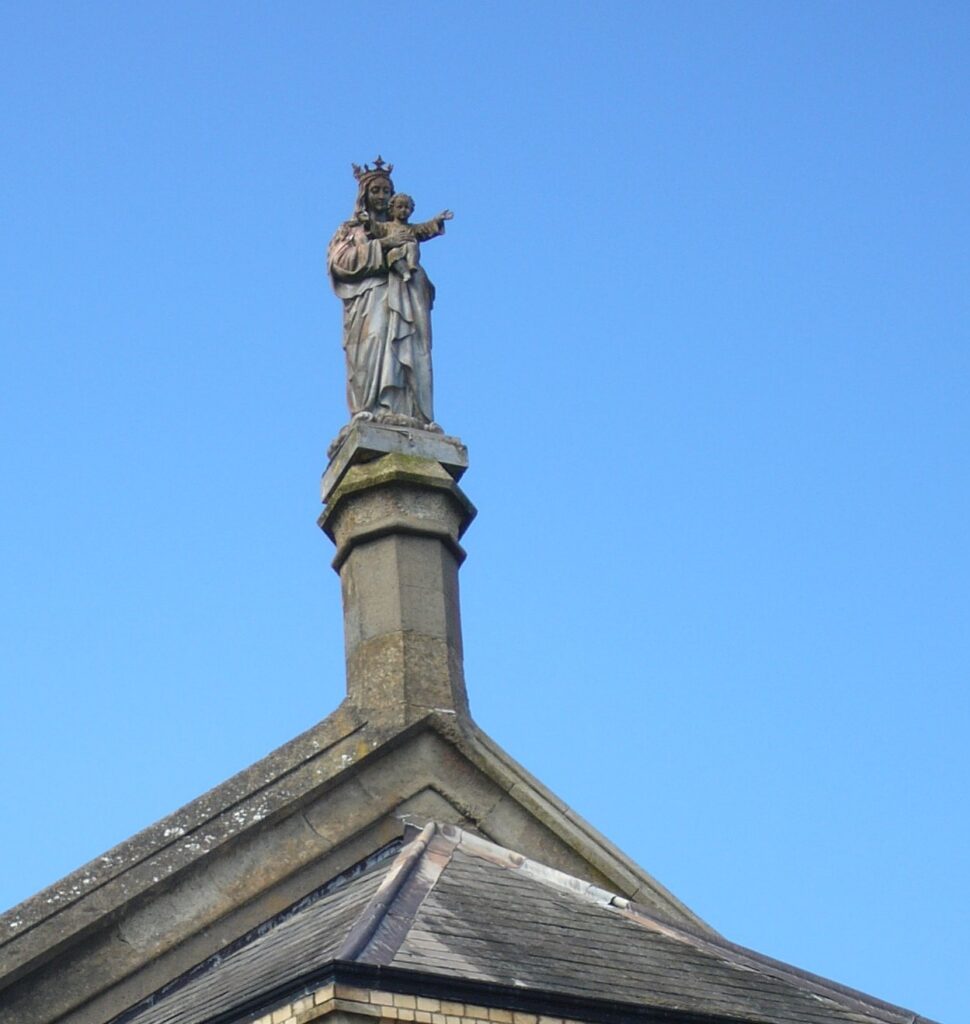
The Chapel was built in the Gothic style with a single nave and a wagon shaped vaulted roof. It is 78ft long, 31ft broad and 58ft high from ground to apex. On the roof above the eastern gable is a cast iron statue to “Our Lady”, although she is also sometimes referred to as “The White Lady”. The statue used to be illuminated at night, and boats would use it as a landmark when returning to port at night.
Catholics continued to worship at the Marist Chapel from 1883, but it was a steep climb up the hill for the townspeople of Paignton. In 1896 a new Parish Priest arrived in Paignton – a strong, healthy, energetic missionary called Fr Mulkern. His aim was to make it easier for people to get to Mass, and so he purchased the Baptist Chapel at the foot of St Mary’s Hill for £300, and this was used for Catholic worship until the 1920’s. It was blessed on the evening of 23rd May 1898 under the title of The Sacred Heart, and on the following morning Bishop Graham opened the Church with a High Mass.
Fr Mulkern had a great reputation for wit – one story tells:
O ne day, Harry Rossiter was taken by Fr Mulkern to see how the work in the ex-Baptist church was progressing. As they arrived, the workmen were just filling in the bath. Fr Mulkern stood watching for a moment and turning to him said “Well Harry, there goes the last of Original Sin!”
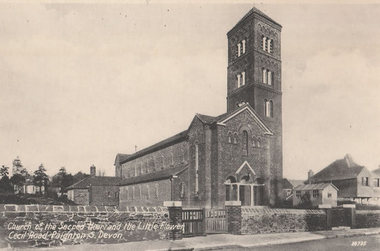
Paignton continued to grow, as tourists flocked to the area, and by the 1920’s the Chapel had become too small for the number of summer visitors. A new Church was planned and in 1924 land in Spratt Lane (now called Cecil Road) was purchased. In July 1931 the new Sacred Heart Church was opened by the 5th Bishop of Plymouth, the Very Referend John Barrett.
The Monastery continued to be used by the Marist Priests until 1971 when the building was sold to Torbay Council, and the Priests left for Heathrop College in London. Over the years since then, it had a number of uses including The Lions’ Club, Victim Support, Nightingales Children’s Project, a food bank and family support centre. In August 2019 the Council gained approval to sell the building by auction at some date in the future, and at the time of writing the news is that Wessex County Assets, a social enterprise, has a project to purchase and refurbish the Monastery for community use and affordable housing. The building is not listed.
Departure of the Marist Order
On 15 July 1984, Fr Sacco had the unenviable task of announcing the final withdrawal of the Marist Priests at Masses, ending the Order’s century of service to the Catholic people of Paignton.
Education
The Order of Marists is an international Order, which originated in France. Their goal is the education of young people.
However, the first record of Catholic schooling in Paignton was by Miss Emily Parkinson, a devout Catholic lady who, in 1893, rented and opened a small one-roomed school at Castle House (now 106 Winner Street) in Barns Hill. In 1885, the school was moved to Miss Parkinson’s own home at Myrtle Cottage in Kirkham Street.
Fr. Grimes took a keen interest in the school, but both he and Miss Parkinson realised that a purpose-built school was a necessity. In 1887, Fr. Grimes left Paignton to be replaced by Fr. John Buckley, who soon found a site at the juncture of Well Street with Oldway Road. The School was built at a cost of £350, and Miss Parkinson continued to teach there for the next 14 years, but refused to accept a salary. Church accounts show a monthly payment of £12 10s, which was duly returned each month to the church as a donation to funds.
Towards the end of 1900, Miss Parkinson’s health was failing. She wanted to retire but would not do so until the future of the school was secure. The Parish Priest by then was Fr. Mulkern, who also wanted to secure the future education of the children, but he also wanted to extend education to a secondary level. He approached Fr. Michael Watters, who was the Father Provincial, and together they arranged for the Marist Sisters to set up a new foundation, and so a small group of Sisters arrived in Paignton to take charge of the Wells Street school and pioneer a secondary school.
On 11th November 1901, the Sisters arrived and set up their first Convent at 1 Southfield Road. In 1905, the Sisters moved convent and school to Willow Bank in Lower Polsham Road. The School had three large classrooms on the ground floor and was set in an acre of land. Numbers increased and by 1907 there were 30 – 40 pupils. However Willow Bank was rented and needed extensive repairs, and so the Sisters looked for a larger property.
Tower House on Mabel Place, a cul-de-sac off Fisher Street, came up for sale. The house was built by Mr Baily in 1890, and stood in about 3 acres of land. The purchase was made possible by Miss Farndell, a benefactor over the years, who lent the deposit for the £5,000 purchase price – a loan she forgave by later gift under her will. Just before Easter 1908 the Sisters moved from Willow Bank to Tower House.
In 1903, a group of Sacred Heart Sisters moved to Paignton from France, and purchased Goodrington House (now Inn on the Quay), on Tanners Lane. They also took pupils, and for a short while there was a slight conflict between the Sacred Heart Sisters and the Marist Sisters regarding charges. Bishop Graham visited Paignton to settle the matter, which he did, but soon after a number of the Sacred Heart Sisters returned to France and gave up their schooling activities.
A sad footnote to the story of the Sisters of Sacred Heart is that by 1913, they had all returned to France. Some were then sent to Liege in Belgium, and during the invasion of the city in August 1914, the Rev. Mother and another sister were shot dead by the Germans, whilst drawing the shutters of their house.
The Marist Sisters continued to teach at both the Fisher Street and Cecil Road schools.

The Marist Convent School got off to a rather slow start, until 1931 when Mother Superior Livinus Hunt was appointed. Under her leadership, the school became one of the best in the area. By the 1960’s, numbers had risen to 287 (including boarders) but by the 1970’s numbers had dropped to 202 with only 27 boarders. In 1950 the Junior School separated from the Senior School, and moved to premises in Oldway Road (now demolished and replaced by Richmond Court).
In 1982 the sad decision was made to close the school.
By the 1930’s, the little primary school in Well Street was becoming overcrowded and was black-listed by Devon County Council. A new modern school was needed, and in 1935 this was opened in the grounds of the Sacred Heart Church on Cecil Road with 73 pupils enrolled. Today, the school is thriving and in 2016 had 251 enrolled.
References:
‘A History and Personal Reminiscences of the Catholic Church in Paignton’ by Betty Adams
‘Torbay’s Heritage – Paignton’ by John R Pike
Sacred Heart Catholic Church, Paignton – Parish History